Turn-based rovers
…extended periods of intense boredom, punctuated by occasional moments of sheer terror.
Though the original quote would appear to be describing warfare, it has been co-opted for any number of fields, including but not limited to mountain climbing, poker and spaceflight. It has not, however, been co-opted for “playing videogames”, for which boredom and terror are generally indicative of a flawed design. Games about spaceflight usually have the fun artificially re-introduced in the form of energy shields, aliens and cool pointy spaceships.
Unfortunately, I’m a sucker for real spacecraft. The stakeholder-approved, slower-than-light, decades-long development type that sends back cool pictures of rocks. Being robots, these ones may have only a few minutes or seconds of terror in their entire lives. This is a design constraint, and one that is totally immovable.
So, how do we make real spaceflight fun?
Games, like spacecraft, tend to start their lives on paper. If a paper game can be fun, then it follows that the same game with more graphics and fewer calculations by hand must be more fun, so I spent a few days doing arts and crafts and came up with this:
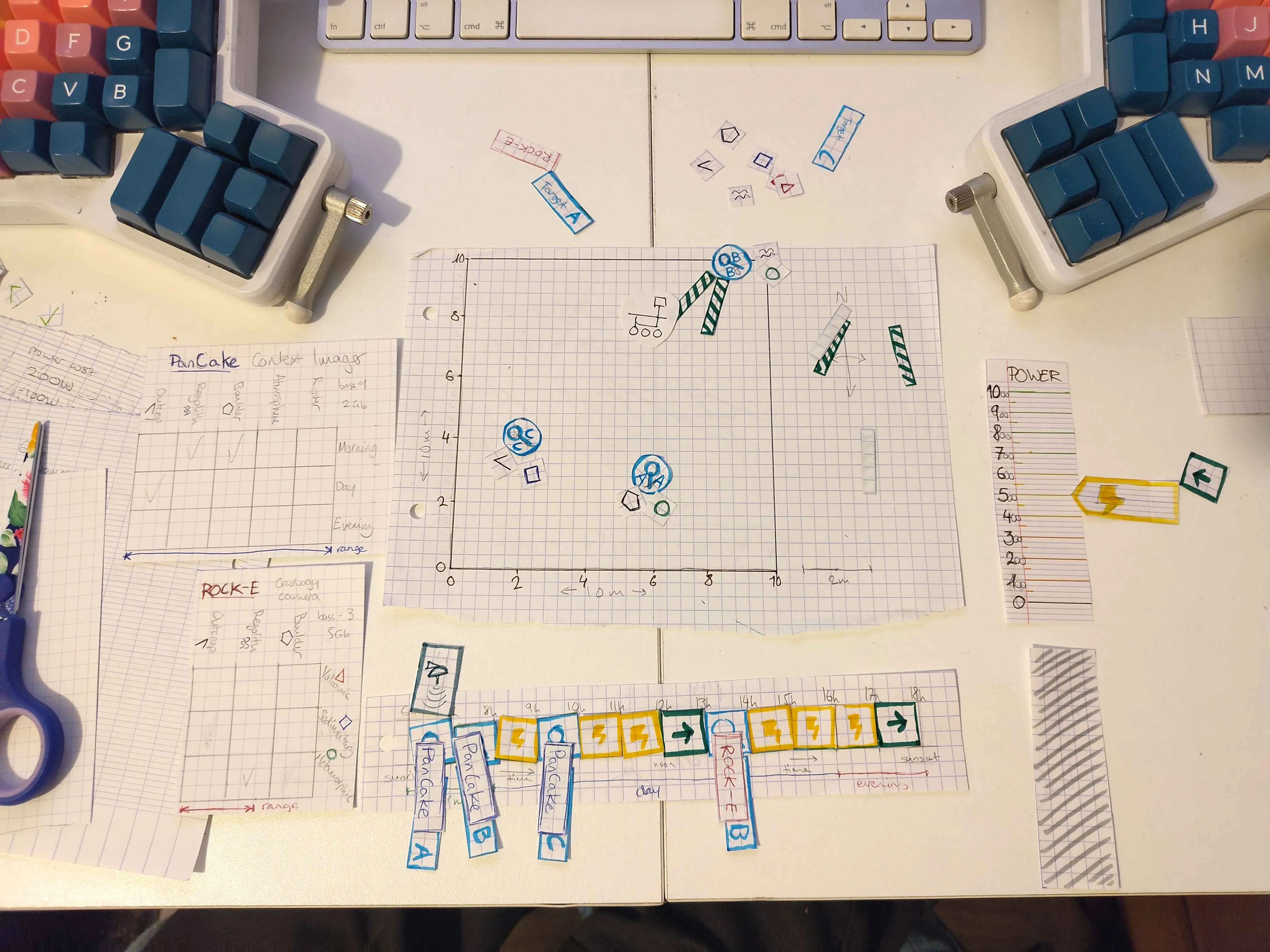
I am now resisting the urge to make a board game instead.
This prototype constrained the design to just what I could manage by rolling dice and moving around bits of coloured paper. For example, in my head before I made anything, the grids on the left used to be n-dimensional, and the bar along the bottom had multiple layers with stretchy blocks. Paper doesn’t stretch, and it’s stubbornly two-dimensional, so I had to get simpler. What I ended up with is without a doubt a superior design.
It also lead me to the key insight that makes the whole thing work, which is that real rovers are turn-based. One of the biggest engineering challenges of real rovers is that they are a long way away, so far that even sending a message takes time. Practically speaking, rovers are operated asynchronously, on hours or days-old information, while teams work around the clock to prepare the next set of instructions as the downlinked data is processed. This asynchrony is a marvel of planning and structure, with a strategic/tactical tradeoff that tickles me in real-time strategy ways. I had to have it.
As I discarded old tokens and cut and folded others into new ones, I thought about how spacecraft designs of today are rarely novel: they trace their lineages back to past spacecraft, building on what came before. This already sounds like a game loop to me, in which we send a rover, learn what we can, and send another. In particular, this reminds me of the go-upgrade-go-again cycle of Everspace. The first probes we sent never tried for life, instead laying the foundations for today’s nuclear behemoths, which might have found it. Similarly, succeeding in your first run of a roguelike - if it’s possible at all - is not the goal you start with. So it’s not a game about a Mars rover, but Mars rovers.
We send rovers to the red planet for science, but all the science happens here on Earth, in labs and universities and research organisations. What the rover sends back is not science but rather data, which is an extreme constraint between here and Mars. Getting a signal across tens of millions of kilometres turns out to be challenging, even before trying to send any kind of information over it. Rover telecommunications is a terribly complex subject, with collected science data subjected to strict prioritisation, most of it being discarded without leaving the surface. However, without being able to see the data you’re returning ahead of time, it’s not always clear what the best data to bring home is. Data in space, as on Earth, is also subject to hardware failures and is particularly subject to radiation, making compression and backup strategies all the more important. This is a low-knowledge optimisation problem, and optimisation games are my favourite.
So there are at least three clear mechanics of Mars rovers with heritage in prior art: strategic versus tactical mission planning; iterative technological progression; and risk-managed downlink optimisation. I’ll explore how each of these work in later posts, both in real rovers and my game. I’ll also try to convince you that for a dead planet, Mars is actually pretty dynamic, and that despite their glacial slowness, rovers are locked in a perpetual race against time. For now though, I’ll leave you with a game I miss dearly and I wish more people could have seen, which changed how I think about games and highlights an opportunity that every other rover game ever has missed: Extrasolar. Our ambassadors to the unknown, it seems to me that a rover game where you know what’s coming next might not be a rover game at all.